




.jpg.jpeg)

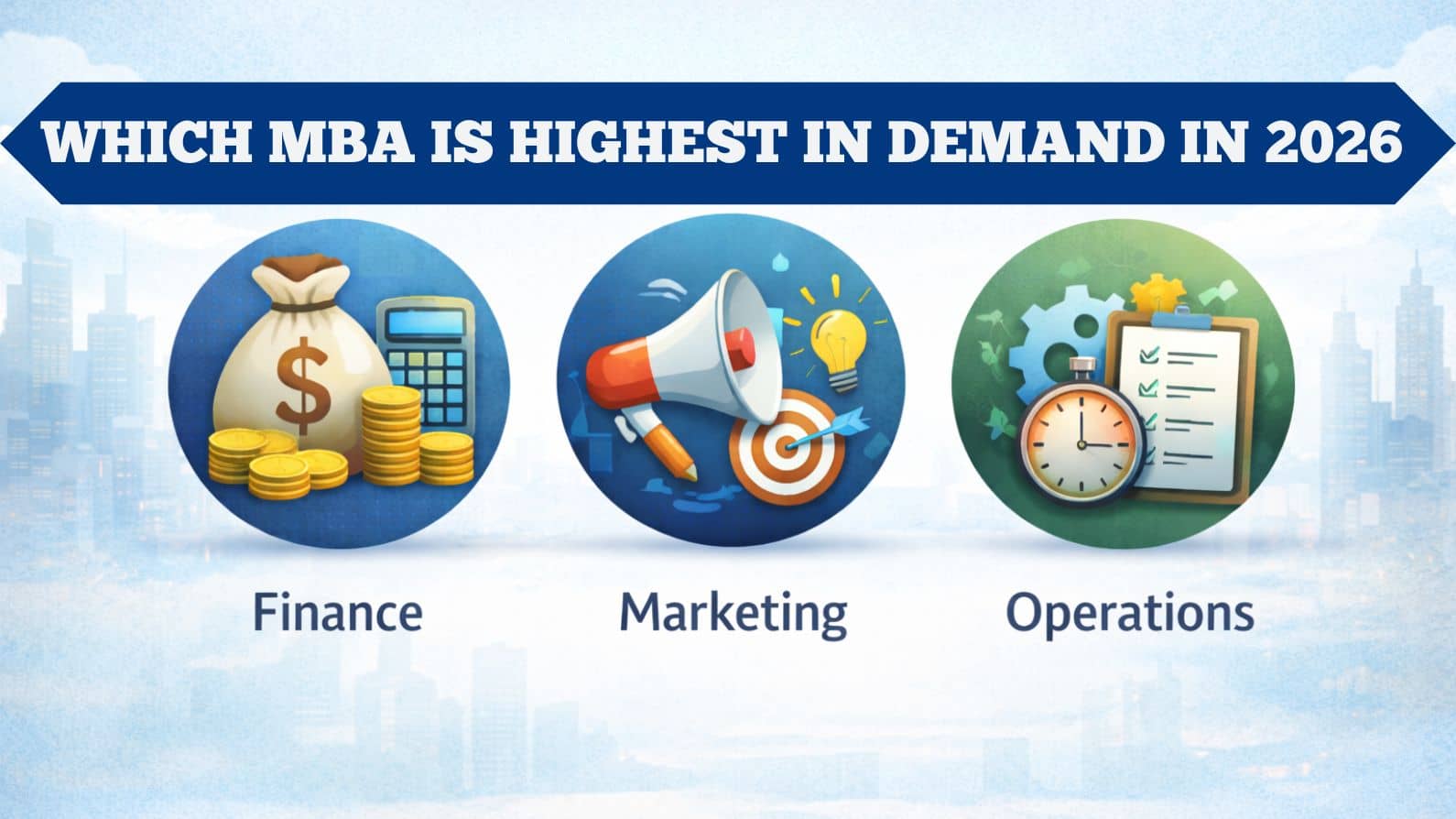
As the industries are changing rapidly, with the advent of technology, international competition, and economic dynamics, the question many job seekers have is: What MBA will be highly in demand in 2026?
The answer clearly depends on the industry trends and employment trends, as well as how a specialisation effectively equips a candidate to address real business problems. Knowing about the MBA specializations in demand and their career scope in India can assist students and working professionals in making a better selection.
Why Choosing the Right MBA Specialization Matters
Having an MBA does not mean high placement rates or a salary. The recruiters are placing more emphasis on specialization-specific skills to suit the industry requirements. There is a wide gap between generic management training and occupational skills.
This is why it is essential to check the MBA specializations list. Certain areas are expanding because of digital change and reforms in policies, and others are stable but competitive. Choosing an MBA course that the industry appreciates will guarantee more relevance in placement opportunities and long-term career growth.
Employers nowadays are focusing more on analytical skills, strategy, and digital awareness, as well as industry exposure, instead of theoretical knowledge alone in the year 2026. Skills are now gaining equal importance to the degree.
Top MBA Specializations in High Demand
The list of the top MBA specializations 2026 in India is provided below based on hiring activity, salary trends, and growth in the industries.
1. MBA in Business Analytics
High demand in the field of IT, fintech, consulting and e-commerce.
Average pay: Rs 8-18 LPA ( higher in the best institutes).
2. MBA in Finance
Consistently in demand in the banking, NBFCs, investment firms and corporate finance.
Average pay: Rs 7-20 LPA, based on position and institute.
3. MBA in Marketing
Strong demand in FMCG, retail, and digital marketing, as well as consumer brands.
Average salary: Rs 6-16 LPA.
4. MBA in Human Resource Management
You need it when most organisations, startups, and IT companies are interested in talent management.
Average salary: Rs 5-12 LPA.
5. MBA in Operations & Supply Chain Management
Increased demand owing to manufacturing growth, an evolution in logistics and e-commerce.
Average salary package: Rs 7-15 LPA.
6. MBA in Data Science / AI Management
The development of specialization associated with technology-based companies.
Average Salary: Rs 10-22 LPA in good institutes.
7. MBA in Digital Marketing
Online-based businesses are rapidly increasing in demand.
Average salary: Rs 5-14 LPA.
8. MBA in Healthcare Management
Consistent demand owing to expansion in hospitals and investments in health care.
Average salary: Rs 6–14 LPA.
9. MBA in International Business
Applicable in export-import companies and international trade assignments.
Average salary: Rs 6–15 LPA.
10. MBA in Product Management
Famous with technology firms and start-ups.
Average salary: Rs 12–25 LPA.
These are the most MBA job-oriented courses which are in line with industry employment trends.
Industry-Wise MBA Demand
Knowing the industry employment trends will also illustrate which specialization fits where.
● Banking and Financial Services: Finance, Business Analytics, and Risk Management.
● IT & Tech Companies: Product Management, Business Analytics, IT and Systems.
● FMCG and Consumer Brands: Marketing, Operations.
● E-commerce and Startups: Digital Marketing, Product Management, Analytics.
● Manufacturing & Infrastructure: Operations, Supply Chain.
● Healthcare and Pharma: Healthcare Management.
● Strategic Consulting Firms: Strategy, Finance, Analytics.
Some of the highest-paying MBAs in India are generally analytics-driven. This sector is consistently experiencing rapid growth.
Salary Trends by MBA Specialization
MBA salary by specialization should be evaluated reasonably. Wages are based on the brand of institutes, background of candidates, internship experience and location.
General trends in India (2026 projection)
● Product Management and Analytics jobs have more packages because of the technical skills.
● Finance jobs are secure but competitive.
● Marketing provides variable payment in terms of performance-based bonuses.
● The starting salaries of HR and the Retail sectors are usually average, whereas their growth opportunities are predictable.
● Logistics and manufacturing are also increasing the operations salaries.
The most lucrative MBA in India is usually via Finance, Analytics or Product positions in top institutes. The initial package is not as important as the depth of skills and exposure to industries for long-term growth.
MBA Demand for Freshers vs Working Professionals..
The demand for fresh graduates and experienced candidates varies.
For freshers:
● Finance, Marketing, HR and Operations are good alternatives.
● Recruiters are interested in internship exposure and communication skills.
● MBA programmes that have high placements tend to be from reputable institutions with corporate affiliations.
For experienced candidates:
● The returns are higher in Business Analytics, Product Management and Strategy roles.
● Many opt for an Executive MBA or a part-time MBA for working professionals to upskill their careers without holding back.
● Employers appreciate domain experience with managerial education.
Skills vs Degree: What Employers Value More
An MBA degree gets you through the door, but skills keep you going. Companies mostly evaluate:
● Analytical capability.
● Digital literacy.
● Financial understanding.
● Communication and negotiation.
● Problem-solving skills
One example is an MBA in Finance, where if someone lacks good skills in Excel, financial modelling, or valuation may struggle. On the same note, an MBA in Marketing candidate who does not know how to conduct digital campaigns might have few chances. That is why candidates should consider MBA programs as the platforms to develop competencies, rather than get credentials. The future scope of MBA depends on adaptability and continuous learning. Choosing from various MBA specializations program requires a structured self-evaluation: Students who come from commerce backgrounds may prefer Finance, while graduates often lean toward Analytics or Operations. Select a specialization that complements your prior work exposure to maximise returns. Roles in Product Management and Analytics may offer higher compensation but demand stronger technical expertise. Specialization like Operations and Finance tend to remain steady across economic fluctuations. Assessment of institution-specific placement data to assess realistic career outcomes. Industries such as data analytics, technology, and healthcare establish strong long-term growth potential in India There is no accurate answer for which MBA is most demanded in 2026. However, according to the present trends in hiring in India, Business Analytics, Finance, Product Management and Operations are some of the MBA specializations in demand. In case the major objective is salary, it is typical to find Analytics and Product Management listed among the highest paying MBA options in India. If the importance is placed on stability, Finance and Operations have a steady demand. Marketing could be of interest if you like creativity and brand-building. Finally, the MBA career scope in India depends on the suitability of your specialization to the market demand, your skill level and your long-term career objectives.How to Choose the MBA Program Based on Your Profile
Academic Qualification
Professional Experience
Risk Tolerance
A Long-Term Career Security
Placement Performance
Industry Expansion Potential
Conclusion: