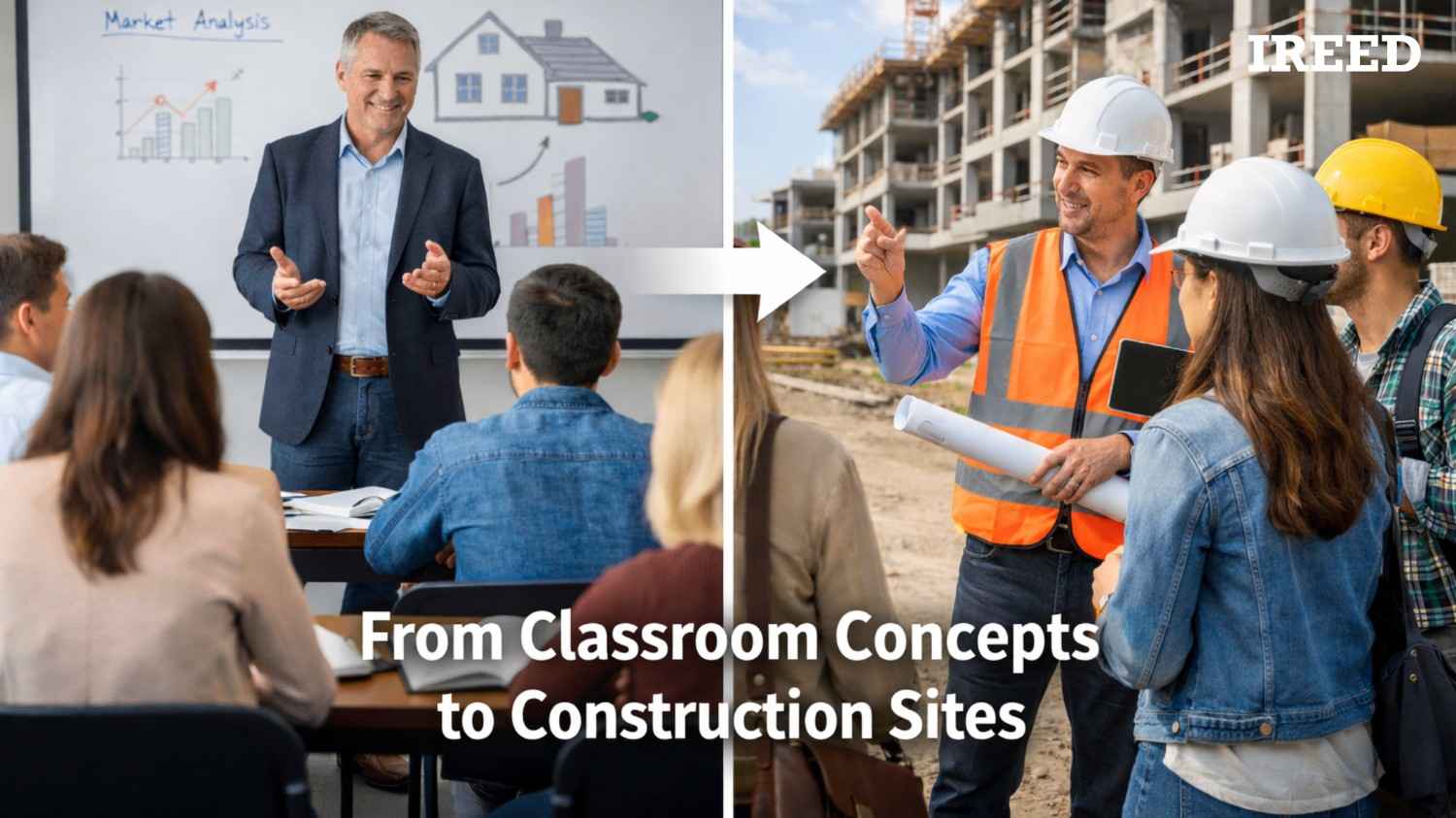
The real estate business is dynamic in terms of its operations, subject to regulations, market cycles, customer behavior, and location-specific factors. The use of traditional learning methods in a classroom setting usually has difficulty addressing this complexity. This has led to the necessity of learning beyond the classroom in real estate.
Contemporary students want educational programs to be more realistic about market conditions. Developers, brokers, and consultants are now seeking professionals who have the knowledge of transactions, project implementation, and interaction with customers. This has compelled organizations and training institutions to expand learning platforms beyond physical classes.
This aspect of requiring versatility has been a major influencer in real estate education trends, with experiential learning being a major part of it and no longer an add-on.
Traditional Classroom-Based Real Estate Learning
Real estate education has been based on classroom-based learning. It is more oriented towards formal teaching, understanding of concepts and teacher-centered discussions. The learners are introduced to the main concepts, definitions, and frameworks that rule the industry.
The above-mentioned methodology introduces rigor, uniformity, and a controlled ambience for learning. It is mainly helpful for students who need to be taught the basic concepts. Besides, interactions among students in class and through discussions also promote learning under guidance and through peers.
However, traditional methods have limitations. Negotiating, site assessing, and market judging skills are essential for a successful real estate transaction, and these cannot be learned exclusively through theory. The challenges have resulted in the transformation of real estate education methods in the whole industry.
Shift From Theory to Practicality and Real-world Learning
The most visible transformation in education is the shift toward practical real estate education. Contemporary courses are structured around the questions of how, rather than what and why. Students are advised to learn from real situations, market dynamics and in-field decision-making.
Case, market simulation, project discussion, and field exposure are all part of experiential learning. Such techniques assist learners in relating theory to reality and acquiring problem-solving skills.
The shift is suggesting a wider trend toward industry-focused real estate education in which learning outcomes are directly related to professional preparedness as opposed to academic attainment.
Role of Site Visits in Modern Real Estate Education
Site visits are now an important part of modern real estate education. They enable learners to see projects, construction phases, location dynamics, and operation issues in real life. This exposure assists in building the gap between theoretical knowledge and practice.
Site visits enable learners to understand the processes of layout planning, development of infrastructure, issues of compliance, and knowledge of the buyer. Such experiences create contextual awareness, which cannot be fully simulated in classroom discussions.
Site visits are also useful in hands-on real estate education since they enable learners to build on observational and practical judgment. It also boosts self-esteem in the process of entering a profession.
How Industry Expectations Are Shaping Education
The property market is recognizing practitioners who can make a positive contribution from the first day. Employers require knowledge of market procedures, the documentation process, customer management, and project analysis. These demands are transforming the real estate education trends in learning platforms.
Educational models are now tailored according to the industry workflow. The emphasis is shifting from academic knowledge to functional competence. This alignment will allow learners to understand how theory is applied in actual business conditions.
Consequently, this has led to the significance of industry-oriented real estate learning making collaboration between industry practitioners and educators more frequent.
Benefits of Hands-On Learning for Real Estate Aspirants
Practical training is beneficial to future real estate practitioners in several ways. It enhances retention, develops and strengthens confidence, and refines decision-making. Students gain a better insight into market forces and underlying operational issues.
Hands-on real estate Training also assists one in determining his or her strengths and interests in the industry. The exposure to different aspects of real estate enables one to make a sound decision in their profession and be realistic.
The learners are better equipped through real-life situations to cope with negotiations, dealing with clients and changes in the markets. The long-term career in real estate and flexibility are made possible by this experience in the field.
What This Evolution Means for the Future of Real Estate
The further evolution of real estate education is an indication of the future where learning is immersive, flexible and bound to industry demands. The education will also become more integrated with direct learning, like visits to sites, case studies, and exposure to the market.
Professionals are required to balance between knowledge and implementation and adapt quickly to the dynamism in the market. The learning models that facilitate such a balance will be relevant and effective.
With the changing real estate learning methods, the focus will be on how to equip the learner to handle real-life situations and not necessarily on academic performance.
Conclusion
The journey from classes to the field trips demonstrates how property education is adjusting to the realities of the industry. Though the classical methods of learning provide the required basics, they cannot be done away with anymore. The shift towards real estate practicality is a sign of the need for those who are familiar with the theory and practice.
Education is becoming more relevant, interesting and career-oriented through the use of an experiential approach and learning outside the classroom in real estate.







.jpg.jpeg)