




.jpg.jpeg)

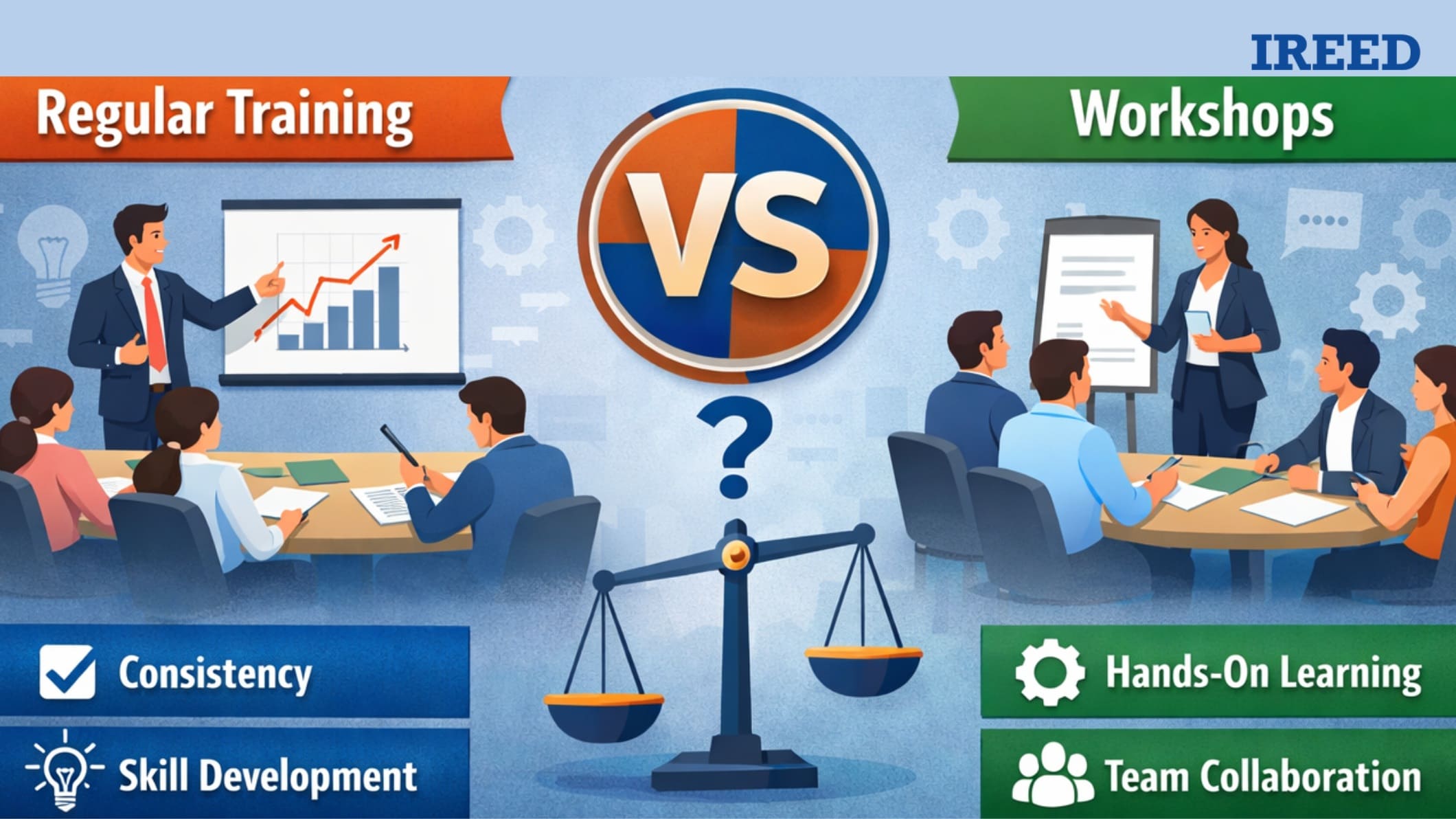
To determine which method works better in enhancing employee performance, we have to look at the manner in which performance is developed at work.
Performance Is Built Through Practice And Not Exposure
Employee performance would be enhanced when individuals:
Repeatedly apply skills
Receive feedback
Correct mistakes
Gain confidence through use
The benefit of workshops primarily is exposure to concepts, models, and worldviews. Practice is provided through regular training. And performance is a process that requires practice, not consciousness.
Being aware of what to do is not being able to do it all the time. Workshops are content with knowledge. Frequent training is an extra-to implementation. Workshops can be used in case the goal is: Introduce a new concept. Align teams on direction. Develop urgency or motivation. Break the traditional line of thought. They make employees know why something is important. Performance, however, demands reliability; doing the right thing a number of times, even under stress. Workshops rarely provide: Enough repetition Real-time correction Ongoing reinforcement Consequently, the improvement of performance due to workshops is usually local and temporal. High performance is based on consistency. Constancy is achieved through regular training by: Increasing skills with time. Allowing learning to mature Integrating behaviors into work. Employees do not merely experiment with the new behaviors, but perfect them. In the long-run, better performance becomes the norm and not the exception. This is particularly important in those jobs that require: Sales and negotiation People management and leadership. Customer service CRM and process-driven work These positions require consistency and not sporadic greatness. Lack of confidence is one of the greatest performance obstacles. The impetus gained through workshops might be effective in the short run, yet the confidence that was created based on inspiration goes away easily. Constant training gains confidence. The employees build confidence since they: Rehearse on several occasions. Handle real challenges. See measurable improvement. Employees who feel confident work better, make more ownership decisions and stronger ones, which have a direct effect on the results. Workshops tend to work in improving intent. Employees leave thinking: "I should do this differently." "This makes sense." However, the intent does not alter output. Periodic training transforms intention into practice through: Leading behavior changes in phases. Addressing real obstacles Decision to hold employees to account in the long run. When learning is incorporated into work, performance is enhanced as opposed to an interruption. Regarding the aspect of measurement: Workshops produce effects in feedback and levels of engagement. Frequent training has reflected results in KPIs, productivity and quality. Measures like the number of conversions, the level of customer satisfaction, the reduction of errors, and efficiency are enhanced with time through reinforcement. The improvement is seldom induced by one learning experience. Improvement based on workshops can tend to rely on: Individual motivation Memory of the session Personal initiative Routine training establishes organizational prowess. It: Uniform best practices. Minimizes variation of performance. Makes success repeatable. This lessens reliance on fewer performers who do better jobs and increases the level of performance of the team. The workshops are effective as they: They are high-energy. They are visible. They generate instant conversation. Training regularly is less noisy. Its influence is not dramatic. However, business performance does not often get better by moments; it gets better by systems. The good performing organizations do not have to decide on the workshops and the usual training. They allot to each its right role: Workshops where ideas and thinking are introduced. Periodic development of skills and performance through training. The dilemma comes when the same task of regular training is supposed to be carried out in workshops. In case the question is limited to the issue of employee performance, it can be easily answered: Awareness and motivation are enhanced in workshops. The advantage of regular training is an improvement in execution and outcome. Inspiration does not achieve performance but constant behavior does. And steady conduct is only made by systematic training. Workshops have their place. They open their minds and initiate talks. However, regular training will have much more impact when the organizations are seeking measurable and sustainable enhancement in the performance of the employees. In the case of leaders who are more outcome-oriented and not activity-oriented leaders, the decision is easy-peasy: Workshops should be used to generate interest--yet regular training should be invested in to generate performance.Workshops Make Knowledge, Not Reflexivity
Read More: Academic vs Corporate TrainersConsistency is Created by Regular Training
Confidence Comes From Repetition
Workshops Enhance Intention, Training Enhances Production.
Measuring Performance Over Time Favors Regular Training
Dependency vs Capability
Why Workshops are Still More Impactful.
The Best Performance Strategy Uses Both Properly
Final Conclusion: What Is Better for Performance?
Conclusion