




.jpg.jpeg)

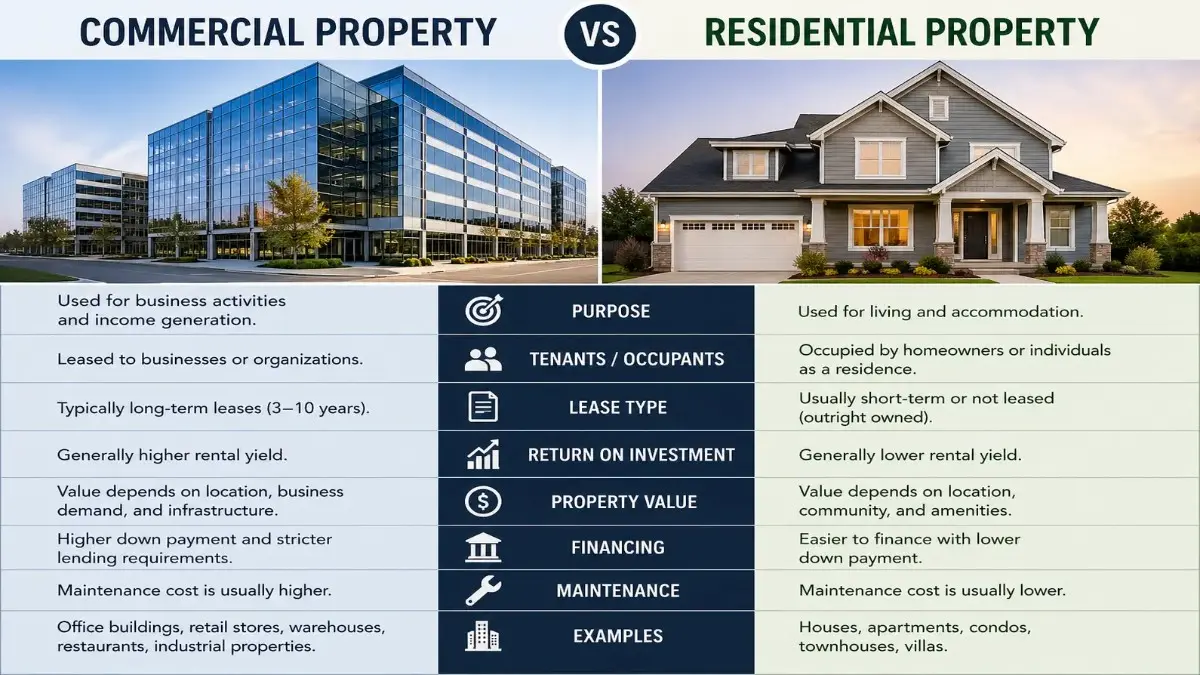
Every property in India falls into one of two fundamental categories — residential or commercial — and understanding the difference between the two could be the most important decision you make as a buyer, investor, or real estate professional. Whether you are a first-time homebuyer trying to understand your options, an investor evaluating yield potential, or areal estate agent advising clients, knowing how commercial and residential properties differ in terms of purpose, taxation, financing, returns, and legal framework is absolutely essential. This complete guide breaks it all down — clearly, simply, and with real Indian market data.
India's real estate market is one of the most dynamic in the world, projected to reach USD 1 trillion by 2030. Within this booming landscape, commercial and residential properties serve entirely different purposes, attract different buyers, offer different returns, and are governed by different legal and regulatory frameworks. While residential properties cater to private living spaces, commercial properties are tailored for business and income generation. Understanding where these two worlds diverge — and where they intersect — is the foundation of smart real estate decision-making in India today.
3–5% Residential rental yield
6–10% Commercial rental yield
15–35% Residential appreciation
13–15% Commercial annual returns
What is residential property?
A residential property is any real estate designed and designated for people to live in. It is built exclusively for personal use and cannot legally be used for industrial or commercial purposes. Residential properties are where families make their homes, where individuals rent apartments, and where communities are built.
Types of residential property in India
Independent houses and bungalows
Apartments and flats (1BHK, 2BHK, 3BHK)
Villas and row houses
Gated community developments
Studio apartments and service apartments
Affordable housing and government housing schemes (PMAY, MHADA)
Plotted residential developments
What is commercial property?
A commercial property is any real estate used primarily for business purposes — to generate income or profit through trade, services, offices, retail, or industrial activity. Commercial properties are leased or purchased by businesses, corporations, and investors seeking higher yield returns.
Types of commercial property in India
Office spaces and IT parks
Retail shops, showrooms, and malls
Hotels and hospitality properties
Warehouses and logistics hubs
Industrial units and manufacturing facilities
Co-working spaces
Mixed-use developments (retail + office)
Raw land held as a business asset
Key differences between commercial and residential property
Residential properties in India typically generate a gross rental yield of around 3%–5% of the property's market value each year. In comparison, commercial properties generally provide higher rental yields ranging between 6%–10%. Data also indicates that long-term returns over ten years are estimated at roughly 8%–9% annually for residential real estate, while commercial real estate may deliver about 13%–15% per year. Lower entry cost Easier to find tenants Simpler financing (home loans) Lower maintenance Higher appreciation potential Stable demand — always needed Tax benefits (Section 80C, 24B) Higher rental yields (6–10%) Longer lease tenure (3–9 yrs) More passive — tenant manages fit-out Annual rent escalation clauses Business credibility asset Depreciation tax benefits Stronger cash flow potential Commercial property loans in India generally require a higher down payment and have stricter lending criteria. Interest rates can be higher, and loan terms may be shorter compared to residential loans. Home loans in India typically come with lower interest rates and require a smaller down payment compared to commercial loans. They are generally easier to obtain, with more flexible terms for borrowers. While a loan for a residential property is in the name of the individual owner, a commercial property loan is in the name of the business entity. The process and paperwork for a commercial property loan are also lengthier compared to residential loans. Commercial properties usually face higher property taxes and benefit from accelerated depreciation. Residential properties have lower taxes and depreciate over a longer period, with different rules for rental income. Residential: Exempt from GST on ready-to-move units; tax benefits under Section 80C (principal) and Section 24B (interest) on home loans Commercial: GST applicable on rent and commercial transactions; higher property tax rates; depreciation benefits available for businesses Commercial investment delivers higher yields (8–15%) and more passive income, while residential offers better appreciation (15–35%+) and tax benefits. The right choice depends on your priority — cash-flow (commercial) or growth (residential). Are a first-time investor Want lower entry cost Prefer stable, low-risk returns Want long-term appreciation Need easier financing Want simpler management Have higher capital to deploy Want higher monthly yield Prefer long-term stable leases Have real estate experience Can manage business tenants Want portfolio diversification "Many experienced investors diversify their property portfolios rather than focusing on a single type. A common strategy is to begin with residential properties — which are generally easier to manage and require lower initial investment — and then diversify into commercial as capital grows." To check whether a property falls under the commercial or residential category, you can check the related property documents. A title deed and land-use certificate outline the property type and intended use. You can also contact the local municipal department to know the zoning regulations applicable to the area concerned. Check title deed — clearly states property type and permitted use. Land-use certificate — issued by local authority confirming zoning. Municipal zoning maps — contact your local corporation or planning department. RERA project registration — check project type on your state RERA portal. For aspiring real estate agents, brokers, and consultants, understanding the difference between commercial and residential property is not just academic — it directly impacts which clients you can serve, which developers you can partner with, and how much you can earn per transaction. Commercial real estate transactions carry significantly higher values, meaning even a 1% commission can translate to substantial income. IREED India's comprehensive real estate programmes cover both residential and commercial real estate — from RERA compliance and property valuation to commercial lease structures and investment analysis — giving you the full-spectrum knowledge to advise any client confidently. Want to master both commercial and residential real estate? IREED India has India's most comprehensive real estate education programmes. The difference between commercial and residential property goes far beyond just purpose — it touches every dimension of real estate, from financing and taxation to risk, returns, and regulatory compliance. Residential property offers stability, accessibility, and strong long-term appreciation, making it the natural starting point for most Indian investors. Commercial property, on the other hand, offers higher rental yields and longer lease security — but demands greater capital, experience, and market knowledge. The smartest investors in India's booming real estate market do not choose one over the other — they understand both deeply and build diversified portfolios that balance growth with income. And the smartest real estate professionals — agents, brokers, and consultants — master both segments to serve a broader client base and close higher-value deals. Whether you are an investor deciding where to put your capital, or an aspiring real estate professional building your expertise, the foundation is the same — education, knowledge, and the right guidance. IREED India is where India's best real estate professionals begin. Start your journey today.Rental yield comparison — residential vs commercial in India
Residential — Pros
Commercial — Pros
Financing differences — home loan vs commercial property loan
Tax differences — residential vs commercial property
Which is better — commercial or residential property investment in India?
Choose Residential if you:
Choose Commercial if you:
How to identify commercial vs residential property in India?
Why do real estate professionals need to master both property types?
Conclusion