


.jpg.jpeg)

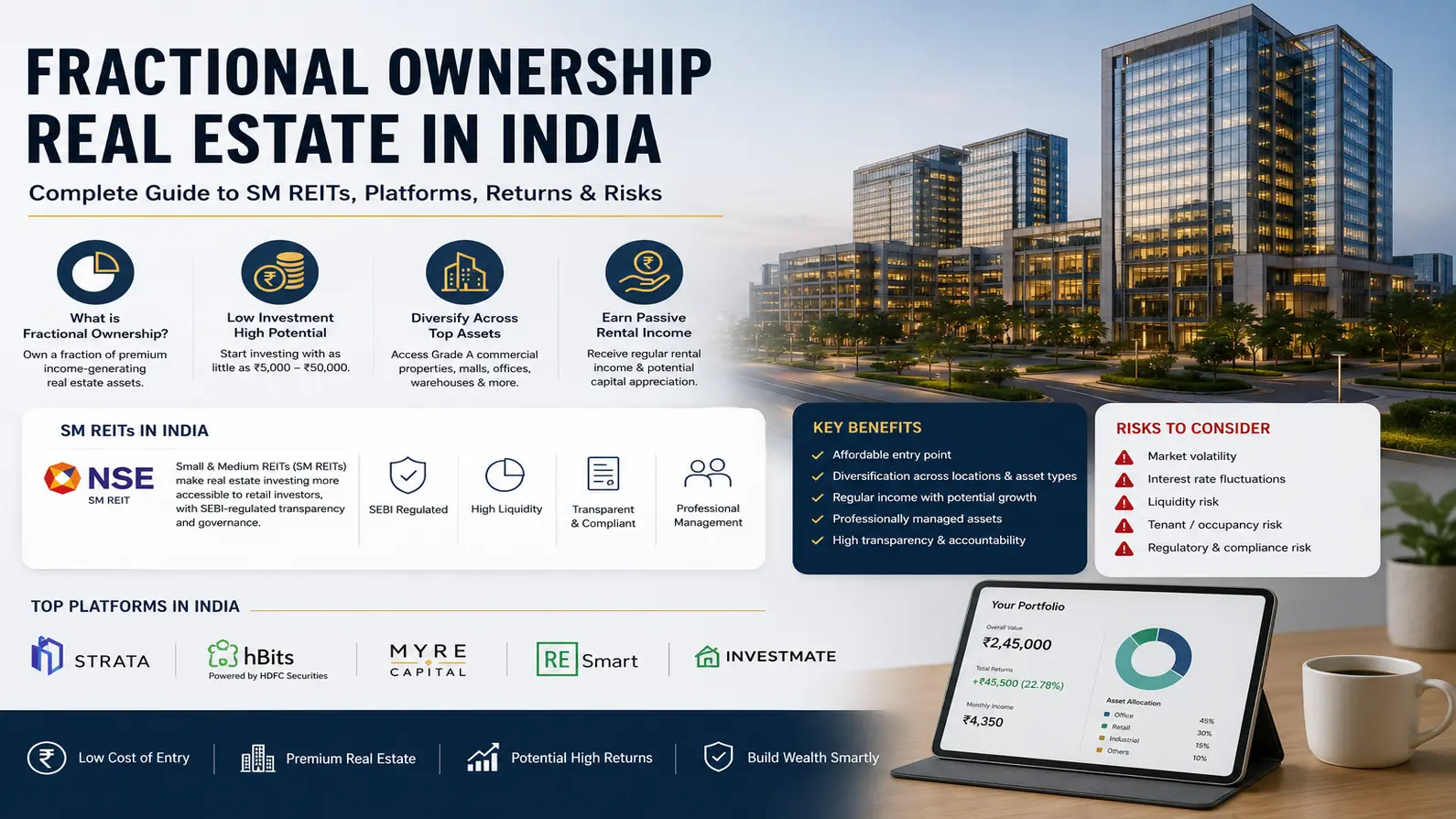
Fractional ownership has transformed Indian real estate investing from a game exclusively for the wealthy into one of the most accessible, regulated, and high-yielding investment structures available to retail investors in 2026. The fractional real estate market in India has exploded from ₹2,300 crore in 2021 to an estimated ₹9,800 crore in 2026 — a 4x growth in just five years — powered by SEBI's landmark SM REIT framework that has brought over 15 major fractional ownership platforms (FOPs) under formal regulation, transforming what was once a grey-market investment into a fully transparent, legally protected asset class. With a minimum ticket size of just ₹10–25 lakh, fractional ownership now gives retail investors direct access to premium Grade-A office spaces, warehouses, data centers, and branded hospitality assets that previously required ₹5–50 crore in direct investment. Annual yields of 8–10% from rental income — significantly above residential real estate's 3–5% — combined with SEBI regulation, professional management, and growing secondary market liquidity are making fractional ownership India's most exciting new real estate investment category. This complete 2026 guide covers everything you need to know — how it works, which platforms to use, what returns to expect, and what risks to watch. ₹9,800Cr Market size 2026 (4x since 2021) ₹10L Minimum investment ticket size 8–10% Average annual rental yield 15+ SEBI-regulated FOPs in India Fractional ownership is a structure where multiple investors collectively own a single high-value real estate asset — typically an office park, warehouse, data center, or hospitality property — at a ticket size of ₹10–25 lakh that would otherwise be impossible for individual retail investors to access. Each investor owns a proportional share of the asset and earns proportional rental income and capital appreciation. In India, fractional ownership operates through two primary structures — Special Purpose Vehicles (SPVs) where the asset is held within a company whose shares are distributed to investors, and SEBI-regulated SM REITs (Small and Medium Real Estate Investment Trusts) where fractional ownership interests are listed on recognised stock exchanges for greater transparency and liquidity. Regulatory milestone: SEBI amended the REIT Regulations 2014 to introduce the SM REIT framework on 8 March 2024 — operational since 2025 — bringing fractional ownership firmly into India's regulated investment landscape with disclosure requirements, valuation standards, and investor protections equivalent to listed securities. A SEBI-regulated fractional ownership platform like Strata, hBits, or PropertyShare identifies a Grade-A commercial property — typically a leased office, warehouse, or data center with creditworthy tenants already in place. The platform conducts legal due diligence, RERA verification, valuation, and tenant lease analysis before listing the asset for fractional investment. The asset is placed into a Special Purpose Vehicle (SPV) company or listed as an SM REIT on a recognised stock exchange. Retail investors purchase units or shares representing fractional ownership — with a minimum ticket of ₹10–25 lakh depending on the platform and asset. All investors receive proportional ownership rights, rental income distributions, and voting rights on major decisions. The existing tenant continues paying rent to the SPV or SM REIT — which distributes proportional rental income to all unit holders on a monthly or quarterly basis. Annual rental yields of 8–10% are the typical target, compared to 3–5% for residential rental properties. Distributions are taxed as income in the hands of investors under applicable income tax rules. When the property is eventually sold — typically after 3–7 years — capital appreciation is distributed proportionally to all investors. For SM REIT-listed assets, investors can also exit via secondary market trading on the exchange — providing liquidity that traditional direct property investment simply cannot match. Unlike conventional real estate where selling takes months, tokenized SM REIT shares can be traded in minutes on SEBI-regulated secondary exchanges. Strata - India's leading FOP — Grade-A offices, warehouses, hospitality. SEBI SM REIT registered. ₹25L minimum hBits - Commercial office fractional ownership specialist. SEBI regulated. ₹10–25L minimum ticket PropertyShare - Premium office and industrial fractional investments. Strong institutional backing Assetmonk - South India focused commercial fractional platform. Office and retail assets WiseX - Commercial and hospitality fractional ownership. SM REIT-compliant structure Alyf - Holiday home and hospitality fractional specialist. Premium vacation asset co-ownership YOURS - Luxury hospitality and vacation home fractional ownership platform ResortWealth - Resort and branded hospitality fractional investment with lifestyle benefits Read also: Real Estate Investment in India for Beginners — fractional ownership is the ideal entry point for first-time commercial real estate investors. Grade-A commercial offices — Most popular; leased to MNCs, GCCs, and IT companies. 8–10% yield Warehousing and logistics — Leased to 3PL and e-commerce operators. 9–12% yield Data centers — Leased to hyperscalers and colocation operators. 10–14% yield Retail and high street shops — Leased to brands and F&B operators. 8–10% yield Branded hospitality — Hotels and resorts with management agreements. 8–12% yield Holiday homes and vacation villas — Short-term rental income plus lifestyle benefits. Variable yield Key risks to know: Fractional ownership returns depend on tenant occupancy and rental income — vacancy risk is real. Platform risk exists for unregulated FOPs — always choose SEBI SM REIT-registered platforms. Liquidity, while improving, remains limited compared to listed REITs. Always verify RERA registration of the underlying property before investing. Read also: Commercial Real Estate India 2026 — the complete guide to every CRE segment that fractional ownership platforms invest in. "Fractional ownership has done for commercial real estate what mutual funds did for the stock market — democratised access to an asset class that was previously available only to the wealthy. In 2026, with SEBI regulation providing investor protection and SM REITs offering secondary market liquidity, fractional ownership is not just accessible — it is the smartest way for retail investors to access India's highest-yielding commercial real estate assets." Want to understand fractional ownership, SM REITs, and commercial real estate investment deeply? IREED India investment-focused curriculum gives you the knowledge to evaluate, invest, and advise on India's most exciting new real estate structures. Fractional ownership real estate in India in 2026 has crossed a critical threshold — from a novel concept to a SEBI-regulated, institutionally validated, and rapidly growing investment category with ₹9,800 crore in market size, 15+ regulated platforms, and a growing secondary market for unit trading. The combination of ₹10–25 lakh minimum ticket sizes, 8–10% annual yields from Grade-A commercial assets, professional management, and improving liquidity makes fractional ownership the most compelling new entry point into commercial real estate for India's growing class of retail investors. For real estate professionals, understanding fractional ownership structures, SM REIT regulations, and platform dynamics is rapidly becoming an essential advisory skill — as more clients seek guidance on these investments. IREED India prepares professionals with the comprehensive commercial real estate and investment knowledge to advise confidently across every dimension of India's evolving property investment landscape. Fractional ownership India 2026 — quick reference: Market size: ₹9,800 crore in 2026 — 4x growth since 2021 Minimum ticket: ₹10–25 lakh depending on platform Average yield: 8%–10% annual rental income distributions SEBI regulation: SM REIT framework — 15+ regulated platforms Asset types: Grade-A offices, warehouses, data centers, hospitality Top platforms: Strata, hBits, PropertyShare, Assetmonk, WiseX Liquidity: SM REIT listed assets tradeable on SEBI exchanges Key risk: Vacancy, platform, and liquidity risk — choose regulated platforms onlyWhat is fractional ownership in real estate?
How fractional ownership works in India 2026 — step by step
Step 01 - Platform selects and acquires a premium asset
Step 02 - Asset is structured as SPV or SM REIT
Step 03 - Rental income distributed monthly or quarterly
Step 04 - Capital appreciation and exit
Top fractional ownership platforms in India 2026
Fractional ownership vs REITs vs direct property — full comparison
Types of assets available through fractional ownership in India 2026
Conclusion




Trending Topics
REAL ESTATETRENDINGPOLITICSTECHNOLOGYBUSINESSHEALTH
IREED Associate Aug 21, 2026
Frequently Asked Questions
📊 Popular Reads
Loading items...