


.jpg.jpeg)

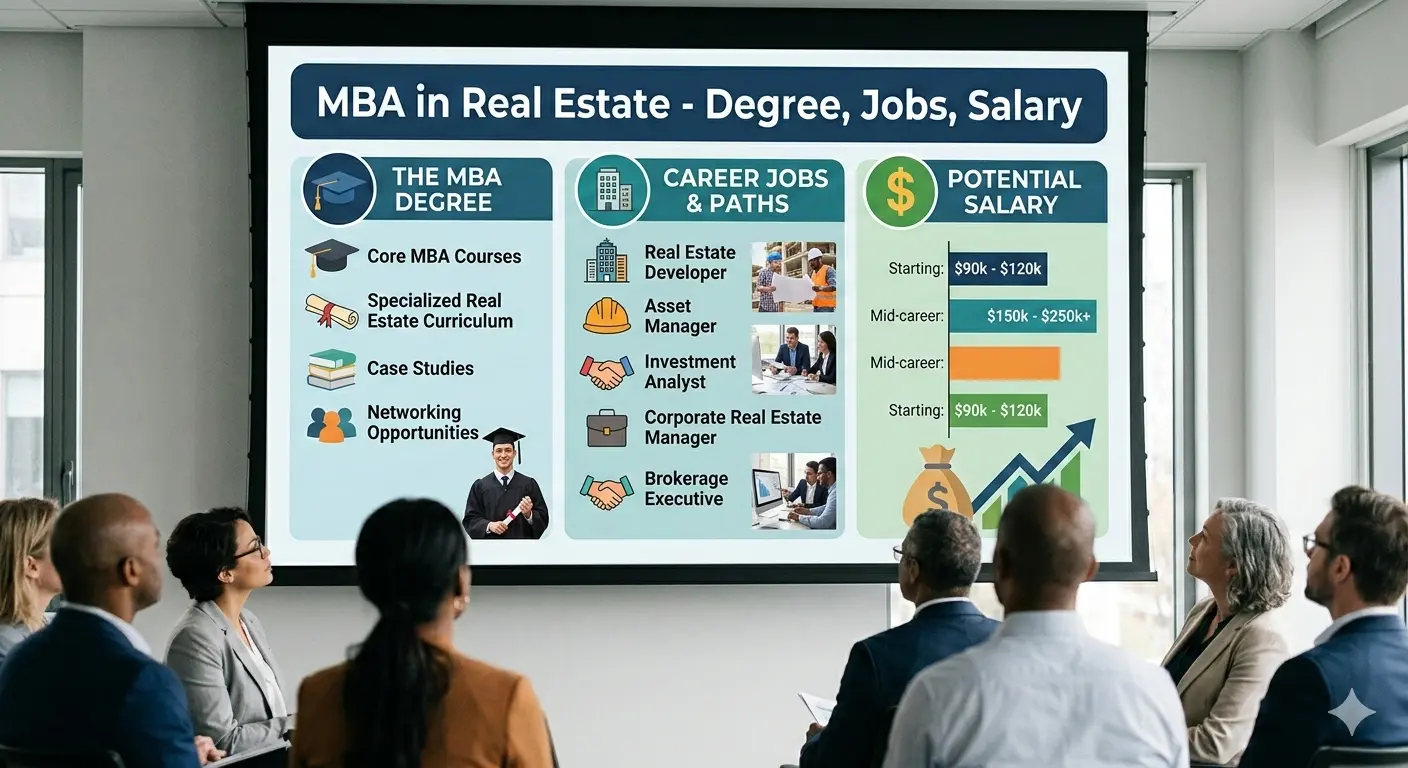
Real estate looks simple from the outside; buy, sell, rent, build. But the moment you step into it professionally, you realize it’s a multi-skill industry that blends business strategy, finance, customer psychology, regulations, operations, and long-cycle project execution. A single residential project can involve land acquisition decisions, feasibility studies, approvals, pricing strategy, channel partner networks, CRM workflows, construction milestones, sales velocity management, and post-handover customer experience. If you’re building a career here, the gap between “knowing property” and “running real estate like a business” becomes very clear. That’s where an MBA in Real Estate becomes relevant. It’s designed for people who want structured business training tailored to property markets; so they can move beyond ad-hoc learning and enter roles with clearer growth paths. In this guide, you’ll understand what the degree typically covers, what kinds of jobs it unlocks across the real estate value chain, and what salary ranges look like in India at different experience levels (using publicly available benchmarks and industry references). You’ll also see how to evaluate the program fit; because the “best” MBA depends heavily on the career track you’re aiming for. An MBA in Real Estate (or MBA in Real Estate Management / MBA in Real Estate & Urban Infrastructure, depending on the institute) is a management degree that focuses on how real estate works as a business. Unlike a general MBA (where real estate may show up as a small elective), this specialization typically goes deeper into real estate markets, development economics, project feasibility, leasing and asset operations, sales and marketing strategy, and investment-oriented decision-making. The real value of the degree is not one subject; it’s the combination. Real estate careers often reward professionals who can connect finance, market demand, pricing, compliance, project timelines, and customer experience into one coherent strategy. A specialized MBA aims to shorten the learning curve for that “connected thinking,” and make you employable across multiple segments; not only brokerage or sales. This specialization tends to work best when you have clarity about the kind of real estate work you want to grow into. Real estate has multiple career lanes; some are relationship-driven (sales, channel), some are process-driven (CRM, operations), and some are investment-driven (asset management, private equity). An MBA helps when you want a structured path into leadership roles across any of these lanes. You should seriously consider an MBA in Real Estate if you relate to two or more of the following: You want to build a long-term career in real estate, not just a “job in property You’re aiming for managerial roles (sales manager, leasing manager, CRM lead, project/portfolio roles) You want stronger fundamentals in finance, feasibility, pricing, or investment thinking You want credibility and structured learning rather than purely field-based trial-and-error You want exposure to the ecosystem beyond residential sales (commercial, warehousing, PropTech, funds) If your goal is purely short-term earning through brokerage, an MBA may not always be the fastest route. But if your goal is structured growth into leadership tracks, it becomes much more valuable. Different institutes structure the program differently, but most MBA-in-Real-Estate curricula cluster around a few practical themes. These themes matter because they map directly to job responsibilities, not just classroom learning. Real estate markets & economics: demand drivers, micro-markets, absorption, pricing behavior Real estate finance: feasibility, cashflows, funding structures, cost control, IRR thinking Marketing & sales strategy: go-to-market, channel strategy, lead management, conversion metrics Regulatory awareness: compliance orientation (often including RERA context), documentation discipline Project & development management: timelines, risk, contractor ecosystem, delivery discipline Asset & property management basics: leasing, operations, tenant lifecycle, NOI mindset (more relevant in commercial) What to look for isn’t “how many subjects.” Look for whether the program builds decision-making capability. The best programs teach you how to read a project like a business: feasibility → positioning → pricing → sales velocity → execution → customer experience. This is a common confusion, especially because real estate has many short-term certifications now (sales, RERA, valuation basics, CRM tools, etc.). Certifications are great when you want to upskill quickly for a specific role. An MBA, on the other hand, is meant to build broader management capability and improve your long-term leadership trajectory. A simple way to decide: Choose certifications if you want targeted skills fast (sales process, negotiation, CRM, RERA basics). Choose an MBA in Real Estate if you want a leadership-oriented foundation spanning strategy + finance + operations + customer. Many professionals actually combine both: they build foundational business capability via an MBA and then add certifications based on specialization (leasing, valuation, project management, PropTech tools, etc.). Real estate is not one job market; it’s a network of job markets. Your post-MBA outcomes depend on which track you choose and how you build your profile (internships, projects, tools, communication skills). Below are the most common tracks where MBA-in-Real-Estate graduates typically fit. This is the most visible track, especially in residential real estate and developer sales teams. It’s high-intensity, target-driven, and can grow quickly if you combine strong communication with pipeline discipline. Common roles include: Presales / inside sales (lead qualification, calling, appointment conversion) Sales executive / sales manager (site conversion, negotiation, closure) Channel partner manager (broker network growth, partner productivity) Business development manager (corporate tie-ups, institutional sales in commercial) This track rewards people who understand both customer psychology and funnel metrics. With an MBA, you’re expected to operate with stronger structure; conversion ratios, lead cost sensitivity, sales velocity, and team management. If you enjoy structured thinking and analytics, this track can be powerful. Modern real estate marketing is performance-driven (digital leads), and modern CRM is about pipeline clarity and customer experience control. Roles can include: CRM manager / sales operations Digital marketing & lead generation (performance marketing, attribution basics) Customer experience / post-sales management Product positioning and brand strategy (more common in larger firms) As the market becomes more data-driven, professionals who can bridge marketing + sales + CRM become extremely valuable. Commercial real estate is often more analytical and relationship-based at the same time. Leasing and advisory roles involve understanding demand, negotiating terms, and managing long-term client relationships. Typical roles: Leasing executive / leasing manager Corporate real estate / occupier services analyst Transaction advisory support (in large consultancies) This track benefits from communication + market intelligence + negotiation discipline. If you’re process-driven and comfortable with timelines, multi-stakeholder coordination, and delivery accountability, development operations can be a strong long-term track. Roles can include: Project coordinator / project management office (PMO) Development operations / planning support Delivery and handover operations This track rewards professionals who can reduce execution chaos and translate plans into predictable outcomes. This is the track many aspirants want, but it’s also the most competitive. It usually requires stronger finance capability, modeling comfort, and often a profile that signals analytical depth. Roles can include: Real estate investment analyst / research analyst Asset management analyst (NOI improvement, leasing strategy, portfolio performance) Fund operations / portfolio support If you aim here, build hard skills early (Excel modeling, feasibility, market research frameworks). Even if you start in a different track, you can move toward this lane with the right skill-building. Salary depends heavily on your role type (sales vs leasing vs investment), your city, your institute brand, and your prior experience. The most credible way to talk about salary is to present ranges rather than one “average,” and to separate entry-level from experienced compensation. Multiple sources report entry-level packages in the ₹3–4 LPA range for fresh graduates in common entry roles. A practical, credibility-first interpretation is: ₹3–6 LPA is common for many entry roles, especially sales/presales/operations. ₹7.5–12 LPA can be achievable in stronger programs or stronger profiles, especially when roles are more consultative or analytical. Salary growth in real estate can accelerate meaningfully once you have 5–8 years of experience, particularly in revenue-linked roles, leadership roles, or specialized domains like investment advisory or PropTech. One iREED India industry blog references ₹20–30 LPA for professionals with roughly 5–8 years experience in certain growth roles. Instead of obsessing over a single number, match salary expectations with role type: Sales leadership can grow fast due to incentives and team targets (variable pay matters a lot). CRM/ops often has steadier fixed pay with predictable growth. Leasing/commercial varies by firm and city; negotiation and network matter. Investment/asset management can pay higher, but entry is harder and skill expectations are higher. To anchor expectations with an external benchmark, Glassdoor’s India estimates for a “Real Estate Manager” role show a broad typical range and top-end reported figures (useful as a directional reference, not a guarantee). Here are job titles that commonly appear on real estate job boards and company career pages; organized so beginners can map them to tracks. Presales Executive / Inside Sales Sales Executive / Sales Manager (Residential) Channel Partner Executive / CP Manager Leasing Executive / Leasing Manager (Commercial) CRM Executive / Sales Operations Project Coordinator / PMO Executive Market Research Analyst (Real Estate) Regional Sales Manager / Sales Head (cluster) Business Development Manager / Head – Alliances Leasing Manager / Commercial Transactions Manager Asset Manager / Portfolio Manager (more specialized) Product/Strategy Manager (developer-side) Investment Analyst / Associate (competitive track) The degree helps most when you can clearly explain which track you’re pursuing and demonstrate the skills that track expects. Skills That Make You Employable (and Promotable) Real estate rewards practical skills more than fancy terminology. If you want strong placements and faster growth, focus on skill signals. Excel + feasibility basics: cashflows, sensitivity, pricing scenarios Communication & negotiation: clear articulation, handling objections, term-sheet basics Market research: micro-market mapping, competitor benchmarking, absorption insights CRM discipline: lead stages, pipeline hygiene, conversion ratios Regulatory and documentation awareness: RERA-oriented mindset, process clarity Presentation and stakeholder management: because real estate is multi-stakeholder by nature If you want to stand out, build a portfolio: market study reports, feasibility mini-projects, leasing case analyses, and sales funnel dashboards. Employers love proof. Choosing the right program is less about the label and more about outcomes: curriculum relevance, faculty-industry connection, internships, and placement quality. Does the program offer internships with real estate developers/consultancies/funds? Does it teach real-world tools (Excel modeling, CRM workflow, market research)? Are there industry projects, guest sessions, and mentorship from active professionals? Does the placement support match your target track (sales vs leasing vs investment)? Are alumni working in the roles you want? Also consider your own profile: if you want investment track roles, pick programs that emphasize finance and analytics; and start building those skills early. Whether you are preparing for an MBA in Real Estate or planning your career after it, structured learning and industry clarity matter. iREED India publishes career-focused insights and salary guidance that can help you set realistic expectations and plan your growth path more strategically; especially around how compensation evolves with experience. If your goal is long-term credibility in real estate, consider building skills in parallel with your degree; sales process discipline, CRM, negotiation, RERA awareness, market research, and business communication. Real estate careers grow faster when you’re seen as a professional who can explain clearly, execute reliably, and create trust in high-stakes transactions. An MBA in Real Estate is a strong option if you want structured entry into the industry and a clearer path toward leadership roles; across sales, channel management, CRM, leasing, project operations, and even investment/asset-oriented tracks. The degree’s biggest benefit is not the certificate itself; it’s the ability to understand real estate as a business system: feasibility → positioning → pricing → marketing → sales → execution → customer experience. When you can connect those pieces, you become valuable across the value chain. Salary outcomes vary widely, and the credible way to view them is through ranges and role context. Entry roles often cluster around ₹3–4 LPA for many freshers, while stronger programs and profiles can move into higher starting ranges like ₹7.5–12 LPA in certain cases. With experience; especially 5–8 years in revenue-linked or specialized roles; compensation can rise significantly, with industry guidance referencing ₹20–30 LPA for some experienced professionals. The best strategy is to choose a track, build the skills that track rewards, and keep your growth anchored to credibility, documentation discipline, and measurable performance. If you’d like, I can also create a career-path version of this blog (same keyword) tailored for students vs working professionals, plus SEO FAQs and internal linking suggestions for iREED India pages; without inflating word count.What is an MBA in Real Estate?
Who Should Consider This Degree?
What You Learn: Curriculum Themes That Matter in Real Jobs
Core learning areas typically include
Degree vs Certification: What’s the Practical Difference?
Career Tracks After an MBA in Real Estate
1) Sales, Presales, and Revenue Leadership
2) Marketing, Growth, and CRM (Lifecycle Management)
3) Leasing, Commercial Advisory, and Occupier Services
4) Project Management and Development Operations
5) Investment, Asset Management, and Real Estate Finance (Advanced Track)
Salary After MBA in Real Estate: What’s Realistic in India?
Entry-level salary ranges (freshers / early roles)
For certain MBA programs and stronger profiles, starting ranges can move higher; for example, a published estimate for an MBA cohort’s expected average starting salary range of ₹7.5–12 LPA appears in an MBA-focused overview of a specialized real estate MBA.Mid-career and experienced salary growth
Role-based salary reality check
Jobs After MBA in Real Estate: Titles You’ll Actually See
Common entry-to-mid titles
Mid-to-senior titles (after experience)
High-impact skills to build during your MBA
How to Choose the Right MBA in Real Estate Program
A short evaluation checklist
Why iREED India is Relevant for MBA Aspirants and Professionals
Conclusion




Trending Topics
REAL ESTATETRENDINGPOLITICSTECHNOLOGYBUSINESSHEALTH
IREED Associate Mar 7, 2026
Frequently Asked Questions
📊 Popular Reads
Loading items...