




.jpg.jpeg)

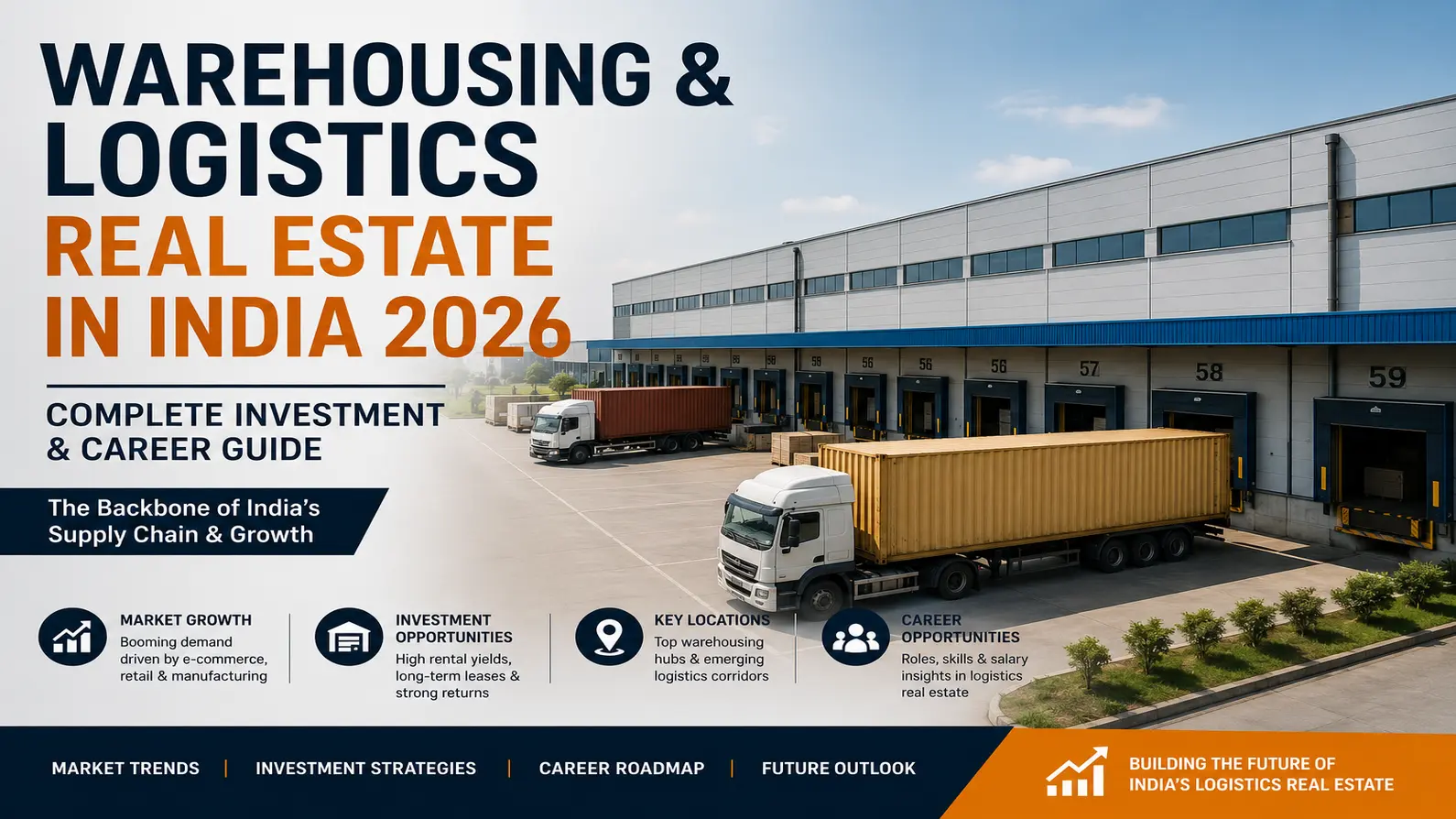
India's warehousing and logistics real estate sector has emerged as the single most exciting commercial real estate investment story of 2026. With Grade-A leasing across top eight cities reaching 11 million square feet in Q1 2026 alone - a 22% year-on-year surge - and the industrial and warehousing sector now representing 9% of all institutional real estate investment portfolios, this is no longer a niche asset class. It is the fastest-growing, most institutionally validated, and most policy-supported segment of Indian commercial real estate today. Driven by the explosive growth of e-commerce and quick-commerce, the China Plus One manufacturing strategy bringing global supply chains to India, the government's National Logistics Policy and dedicated freight corridors, and the push to raise manufacturing's share of GDP from 17% to 25% by 2035, India's warehousing and logistics real estate market is setting records every quarter. For investors, developers, and real estate professionals, this guide covers everything you need to know about India's most dynamic commercial real estate sector in 2026. 72.5M Sq ft absorbed in 2025 - record high 29% Annual rise in absorption 2025 9% Share of institutional portfolios H1 2026 500M Sq ft Grade-A stock target by 2030 Warehousing and logistics real estate refers to industrial properties designed for storing, sorting, processing, and distributing goods - including Grade-A warehouses, distribution centres, cold storage facilities, logistics parks, manufacturing units, and multi-modal logistics hubs. Unlike residential or commercial office real estate, industrial and logistics properties are leased primarily to 3PL (third-party logistics) companies, e-commerce operators, manufacturers, and retailers on long-term agreements with built-in rent escalation clauses. In India, Grade-A warehousing - large, modern, compliant, and professionally managed facilities - has become the preferred asset class for institutional investors including Blackstone, Warburg Pincus, ESR, and GIC, who have collectively deployed billions of dollars into Indian logistics real estate in 2025–2026. The surge in e-commerce and rapid-delivery platforms is accelerating the need for compact, neighbourhood-centric storage solutions - micro-fulfilment centres, dark stores, and in-city warehouses that enable same-day and 10-minute delivery. Platforms like Zepto, Blinkit, and Swiggy Instamart alone are leasing thousands of dark store locations across Indian cities, creating unprecedented demand for small-format urban warehousing that did not exist three years ago. Global manufacturers diversifying away from China are choosing India at scale - driven by the Production-Linked Incentive (PLI) scheme, competitive labour costs, and improving infrastructure. Manufacturing accounted for 47% of all warehousing demand in 2025 - the largest single category. Warehousing deals of 200,000 sq ft or more are driving 40–50% of Grade-A space uptake in 2026 - reflecting the large-format requirements of global manufacturing occupiers setting up India operations. The National Logistics Policy, dedicated freight corridors, Gati Shakti Masterplan, and the development of Multi-Modal Logistics Parks (MMLPs) are fundamentally improving India's logistics infrastructure - reducing logistics costs from 14% to a targeted 8% of GDP. This policy push is also expanding warehousing demand beyond Tier 1 cities - with Tier 2 and Tier 3 cities emerging as key logistics hubs in 2026, particularly along new expressway and freight corridor routes. Warehouse automation is projected to leap from 4% in 2024 to 76% by 2030 - one of the most dramatic technology adoption curves in any industry. Advanced robotics, conveyor systems, and data analytics are becoming operational baselines that command rental premiums - with monthly rents peaking in Pune at ₹28 per square foot for automated Grade-A facilities. Occupiers seeking tech-enabled warehouses are paying 15–25% rental premiums for automated facilities over conventional warehouses. Global occupiers and institutional funds are mandating strict ESG compliance - embedding green metrics into underwriting criteria and lease requirements. Green-certified warehouses with solar panels, rainwater harvesting, LED lighting, and energy-efficient design are achieving 10–15% rental premiums over conventional facilities. By 2026, ESG compliance has shifted from a differentiator to a baseline requirement for institutional-grade logistics real estate in India. Mumbai / Pune Cluster - India's largest logistics market. NH-48 and Bhiwandi corridor dominate. Highest rents - ₹25–32/sq ft/month NCR / Delhi Region - NH-58, NH-24, Kundli-Manesar-Palwal corridor. Strong 3PL and e-commerce demand. ₹22–28/sq ft/month Bengaluru - South India's top logistics hub. Hoskote and Nelamangala corridors. Strong tech and e-commerce demand Hyderabad - Fastest growing logistics market. Patancheru and Shamshabad corridors. Strong pharma and auto demand Chennai - Port-linked logistics strength. Sriperumbudur and NH-44 corridors. Auto and electronics manufacturing hub Kolkata - Emerging major national warehousing destination. Strong growth driven by regional distribution demand Nagpur - Zero Mile City advantage - India's geographic centre. MIHAN SEZ driving 200%+ growth in 2025 Tier 2 Rising - Lucknow, Jaipur, Coimbatore, Ahmedabad gaining - enhanced connectivity and cheaper land driving entry Key insight: Warehousing and logistics real estate delivers India's highest commercial real estate yields - 8–14% annually - backed by the longest lease tenures, strongest tenant profiles, and most powerful structural demand tailwinds of any asset class in India's 2026 market. Industrial & Logistics Real Estate Consultant - ₹10L–₹35L per annum Warehouse Leasing Specialist - ₹8L–₹25L per annum Industrial Property Developer - Project-based, high income potential Logistics Park Asset Manager - ₹12L–₹35L per annum 3PL Real Estate Transaction Manager - ₹10L–₹30L per annum Industrial REIT Analyst - ₹12L–₹40L per annum ESG Compliance Manager (Logistics) - ₹10L–₹28L per annum Read also: PropTech in India 2026 - warehouse automation and AI are transforming logistics real estate at unprecedented speed. "Warehousing and logistics is India's most overlooked real estate opportunity for individual investors and professionals in 2026. While everyone chases apartments in Worli or villas in Sarjapur, the highest institutional yields, the longest lease tenures, and the most powerful demand tailwinds are sitting in a Grade-A warehouse in Bhiwandi, Nagpur, or Hoskote." Want to build expertise in India's fastest-growing commercial real estate sector? IREED India commercial real estate curriculum covers industrial and logistics investment, leasing, and career pathways. Warehousing and logistics real estate in India in 2026 is not just growing - it is setting records every quarter, attracting institutional capital at unprecedented levels, and creating career opportunities that did not exist five years ago. With absorption at 72.5 million square feet in 2025, Grade-A stock heading to 500 million square feet by 2030, and structural drivers ranging from e-commerce and quick-commerce to China Plus One manufacturing and government infrastructure investment, this sector will continue to outperform every other commercial real estate category for years to come. For real estate professionals, industrial and logistics is the highest-earning commercial real estate specialisation available in India today. For investors, it delivers the best risk-adjusted returns of any asset class in the market. IREED India prepares professionals to serve both - with the market knowledge, financial skills, and commercial real estate expertise to lead in India's most dynamic property sector. Warehousing real estate India 2026 - quick reference: Record absorption: 72.5 million sq ft in 2025, 29% annual rise Q1 2026: 11 million sq ft Grade-A leasing - 22% YoY growth Institutional share: 9% of all portfolios H1 2026 Rental yield: 8%–14% across warehouse categories Top markets: Mumbai/Pune, NCR, Bengaluru, Hyderabad, Chennai, Nagpur Key demand: 3PL, e-commerce, manufacturing (47% of demand) Automation: 4% to 76% adoption projected by 2030 Tier 2 emerging: Nagpur grew 200%+ in 2025 - more to follow Target 2030: 500 million sq ft Grade-A stockWhat is warehousing and logistics real estate?
Key drivers of warehousing real estate growth in India 2026
Driver 01 - E-Commerce and Quick-Commerce Explosion
Driver 02 - China Plus One - Global Manufacturing Migration
Driver 03 - National Logistics Policy and Infrastructure Investment
Driver 04 - Warehouse Automation - Technology Premium
Driver 05 - ESG Compliance - Green Warehousing Mandated
Top warehousing and logistics markets in India 2026
Read also: Tier 2 Cities Real Estate Investment India 2026 - Tier 2 cities are the next frontier for warehousing and logistics park development.Warehousing real estate investment - key metrics 2026
Career opportunities in warehousing and logistics real estate
Conclusion


Trending Topics
REAL ESTATETRENDINGPOLITICSTECHNOLOGYBUSINESSHEALTH
IREED Associate Aug 5, 2026
Frequently Asked Questions
📊 Popular Reads
Loading items...