






.jpg.jpeg)

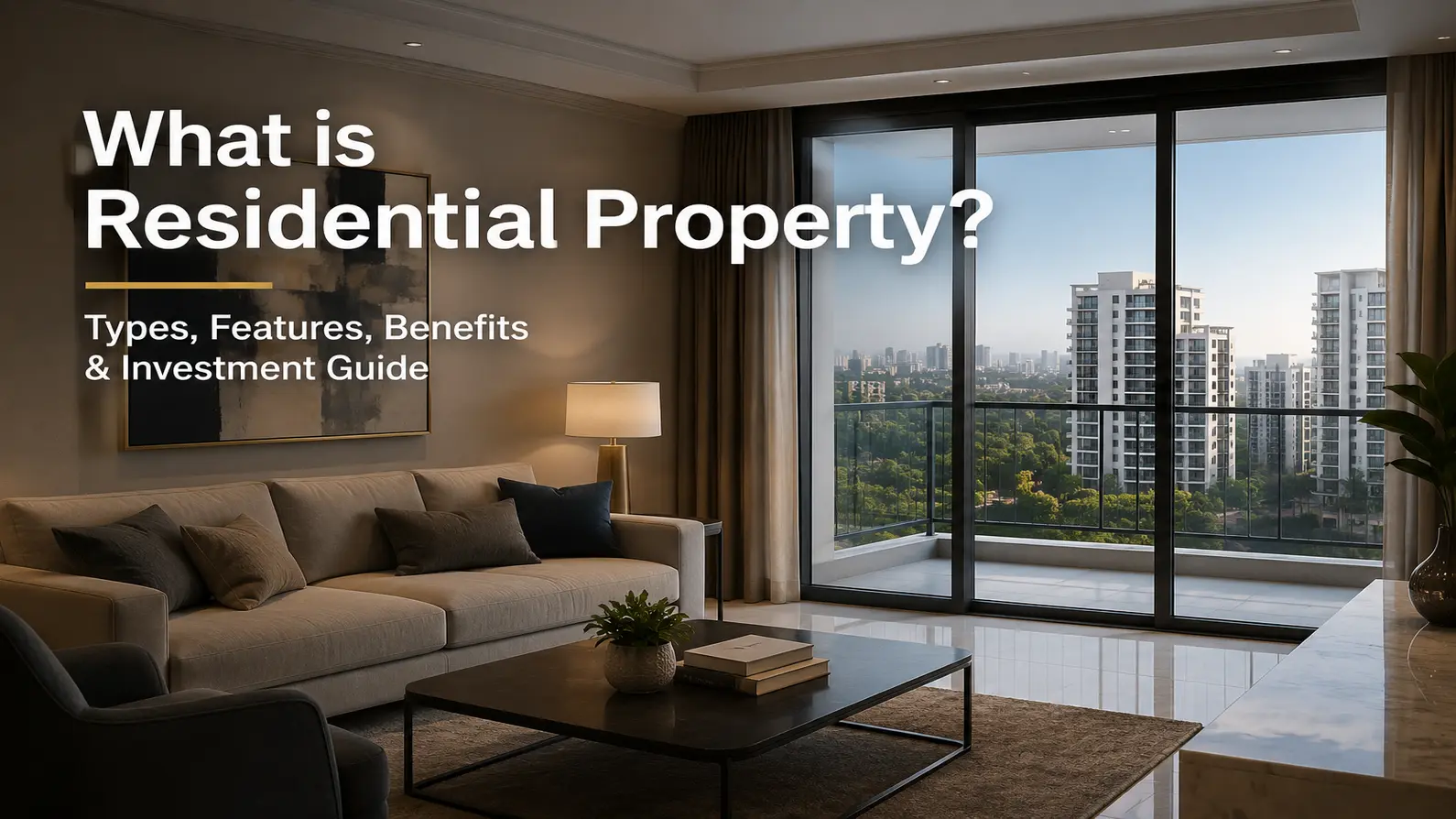
Residential property is any land or building designed exclusively for people to live in — from apartments and independent houses to villas, bungalows, and plotted developments. It is the most widely purchased, most easily financed, and most emotionally significant category of real estate in India. Whether you are a first-time homebuyer, a seasoned investor, or an aspiring real estate professional, understanding exactly what residential property is — and how it works — is the essential foundation of every smart property decision.
India's residential real estate market is one of the largest and fastest-growing in the world, with residential sales reaching 0.3–0.4 million units annually in the post-pandemic era, and this momentum is expected to continue through 2026. From affordable housing schemes in Tier 2 cities to ultra-luxury branded residences in Mumbai and Delhi-NCR, the residential property market serves every income group, every lifestyle, and every investment objective — making it the cornerstone of India's real estate ecosystem and the starting point for virtually every property career and investment journey.
50%+ Market share — apartments
2–4% Rental yield annually
5–8% Capital appreciation p.a.
₹1T Market size by 2030
What is residential property?
Residential property refers to land or buildings meant primarily for housing rather than commercial or industrial use. These include various forms of housing — such as apartments, villas, row houses, and bungalows — tailored to accommodate individuals, families, or groups.
In India, residential properties are regulated by municipal and land-use authorities that define zoning, permissible usage, and development norms. Unlike commercial real estate, residential properties cannot be used for business operations. Their value depends on factors such as location, amenities, infrastructure, connectivity, and prevailing market demand.
Under India's four main property categories — residential, commercial, industrial, and agricultural — residential is the most accessible, most widely understood, and most preferred entry point for first-time buyers and investors alike.
Types of residential property in India
More than 50% of the residential real estate market is accounted for by flat and apartment sales, mainly due to the rapid expansion of cities and limited availability of land. However, India's residential market is far more diverse — here are all the major types:
Type 01 - Apartments and Flats
Most Popular Urban First Choice. Apartments are India's most common residential property type, especially in metro cities where land availability is limited. They range from compact studio apartments to spacious penthouses, often with shared amenities like parking, security, gyms, and swimming pools. Available in configurations from 1BHK to 5BHK+, apartments suit first-time homebuyers, working professionals, and investors seeking rental income.
Most affordable entry point in cities
Shared amenities and maintenance
High demand for rental — consistent income
Managed by RWA or Cooperative Housing Society
Type 02 - Independent Houses and Bungalows
Premium Segment High Privacy. Independent houses and villas stand out for their exclusivity and privacy. These refer to standalone residential units built on a plot of land, providing the freedom to design and customise interiors and exteriors according to personal preferences. Bungalows are preferred by buyers who prioritise accessibility, single-level living, and high privacy. Entry-level prices typically start at ₹2 crore or higher in most urban markets.
Complete privacy — no shared walls
Freedom to renovate and expand
Larger living areas with private garden
Higher purchase and maintenance costs
Type 03 - Villas and Gated Communities
Luxury Segment High Appreciation. Villas are considered premium luxury residential properties in India, often located in gated villa communities or suburban areas. They are ideal for buyers seeking long-term luxury living, enhanced privacy, and greater control over personal space. Popular in cities like Bangalore, Hyderabad, and Pune, villas in gated communities offer exclusive clubhouses, swimming pools, and landscaped surroundings — combining the best of independent living with shared premium amenities.
Premium lifestyle with maximum privacy
Located in gated, security-managed communities
Strong long-term capital appreciation
Popular with HNIs and NRI buyers
Type 04 - Row Houses and Townhouses
Mid-Segment Good Value. Row houses are multi-storey homes sharing walls on either side with adjacent units in a row. They combine the space and privacy of an independent house with the affordability and community feel of an apartment complex. Popular in suburban areas of Pune, Chennai, and Ahmedabad, row houses offer a middle ground between apartment living and independent home ownership.
More space than apartments at lower cost than villas
Community living with semi-independence
Popular in suburban and planned township areas
Ideal for families seeking space and affordability
Type 05 - Builder Floors
Delhi NCR Favourite Independent Feel. Builder floors are independent residential units within low-rise buildings, where a different individual or family owns each floor. They provide the advantage of independent living combined with the convenience of shared infrastructure such as water supply and security. Extremely popular in Delhi, Gurgaon, and Noida, builder floors offer independent home ownership at a more accessible price point than standalone houses.
Entire floor owned independently
More privacy than apartments
Popular in Delhi NCR market
No maintenance charges typically
Type 06 - Studio Apartments and RK Units
Most Affordable High Rental Demand. RK stands for Room-Kitchen, also called a studio apartment. Common in metro cities, these compact, efficient homes lack separate bedrooms or living rooms, ideal for working individuals and students. Studio apartments generate some of the highest rental yields relative to purchase price — making them a popular choice for investors in cities like Mumbai, Bangalore, and Pune where rental demand from working professionals is consistently strong.
Lowest entry cost in residential segment
High rental demand from young professionals
Ideal for investors seeking rental income
Available in all major metro cities
Type 07 - Penthouses
Ultra Luxury Exclusivity. A penthouse is a luxurious top-floor residence in a premium building, offering exclusivity, lavish features, abundant natural light, ventilation, and panoramic views, resembling villa-like independence with private terraces and elevators. Pricing is generally much higher than a traditional apartment but typically lower than a large villa in a prime location — making penthouses the preferred choice for HNIs seeking luxury apartment living with maximum exclusivity.
Top floor of premium high-rise buildings
Panoramic views and private terrace
Ultra-luxury amenities and finishes
Strong appreciation in prime locations
Type 08 - Plotted Residential Developments
High Appreciation Full Customisation. Plotted developments are residential plots within planned townships or gated communities — allowing buyers to construct their own home exactly as they wish. Lifestyle-focused preferences are driving demand for plotted developments, gated villas, and upscale apartments, while investors prioritise emerging micro-markets guided by long-term returns. Plots consistently deliver strong capital appreciation and are increasingly popular as an investment asset class in India's growing suburban and Tier 2 markets.
Freedom to build according to personal vision
Strong long-term capital appreciation
Popular in Tier 2 cities and suburban markets
Lower initial cost than constructed properties
Key features of residential property in India
Understanding what defines a residential property helps buyers, investors, and agents make better decisions and avoid costly legal mistakes:
Purpose: Designated exclusively for living — not commercial, industrial, or agricultural use
Zoning: Located in areas zoned as residential by the local municipal authority
RERA applicability: All residential projects exceeding 500 sq m or 8 units must be RERA registered
Home loan eligibility: Residential properties qualify for home loans at lower interest rates than commercial loans
GST exemption: Ready-to-move residential properties are exempt from GST
Tax benefits: Section 80C (principal repayment) and Section 24(b) (interest deduction) benefits available
Lower property tax: Residential properties attract lower municipal property tax compared to commercial
Electricity tariff: Residential electricity rates are lower than commercial tariffs
Benefits of investing in residential property in India
1. Stable Rental Income
Residential properties generate consistent rental income with lower volatility — driven by India's ever-growing urban population and housing demand.
2. Capital Appreciation
Property values appreciate steadily over time — averaging 5%–8% annually in established markets — driven by infrastructure growth and urbanisation.
3. Tax Benefits
Enjoy deductions under Section 24(b) for home loan interest and Section 80C for principal repayment — reducing your effective cost of ownership significantly.
4. Inflation Hedge
As living costs rise, both property values and rental income tend to increase — making residential property one of India's most reliable inflation-proof assets.
5. Easy Financing
Home loans for residential property come with lower interest rates, smaller down payments, and longer repayment tenures — making it the most accessible real estate investment.
6. Portfolio Diversification
Residential property balances investment risk while providing tangible, stable returns — an ideal complement to equity and other volatile asset classes.
Residential property market trends in India
India's residential real estate market is evolving rapidly. Here are the key trends shaping the market in 2026:
Rise of Tier 2 and Tier 3 cities: Cities like Indore, Lucknow, and Coimbatore are witnessing strong housing demand due to better connectivity and affordability.
Luxury housing boom: Homes priced above ₹1 crore accounted for over half of total sales across major cities, reflecting a decisive shift in buyer aspirations.
Sustainable housing: Eco-friendly designs, solar panels, and energy-efficient materials are becoming key differentiators for residential developers.
Gated community preference: Homebuyers are prioritising security, green spaces, and community living — driving demand for premium townships.
Digital transactions: Virtual tours, e-registrations, and AI-powered property evaluations are simplifying the buying process across India.
NRI investment: Strong NRI participation is driving demand in premium and luxury residential segments across Mumbai, Bengaluru, and Hyderabad.
Residential property vs commercial property
"Residential property is where most Indians begin their real estate journey — as homebuyers, as investors, and as real estate professionals. It is the most accessible, most emotionally resonant, and most consistently demanded category of real estate in the country. Understanding it deeply is the foundation of every successful real estate career."
How do real estate professionals master residential property?
For aspiring real estate agents, brokers, and developers, deep knowledge of residential property — its types, legal framework, RERA applicability, taxation, and market dynamics — is the foundation of a successful career. Agents who can guide buyers confidently through the residential property landscape — from type selection and location analysis to documentation and home loan guidance — consistently outperform and out-earn those who operate on instinct alone.
IREED India is India's top real estate institute, offering comprehensive training that covers every dimension of residential property — from property types and RERA compliance to market analysis, valuation, and sales strategy. Whether you are just starting out or looking to deepen your expertise, IREED gives you the full foundation to advise any client in India's residential market with confidence.
Want to master residential property and build a thriving real estate career in India? Start with IREED India — India's top real estate institute.
Conclusion
Residential property is far more than just a place to live — it is India's most trusted investment asset, the most accessible entry point for first-time buyers, and the foundation of the country's booming real estate market. From affordable studio apartments in metro cities to ultra-luxury villas in gated communities, the residential property segment serves every buyer, every budget, and every lifestyle aspiration.
Understanding the types, features, benefits, and market trends of residential property is essential for anyone who wants to buy, invest in, or build a career in Indian real estate. The more deeply you understand this segment, the better equipped you are to make smart decisions — whether as a homebuyer choosing the right property, an investor maximising returns, or a real estate professional advising clients with confidence.
IREED India is where India's most successful real estate professionals begin — with the knowledge, credentials, and market expertise to lead in every segment of India's property market.
Quick reference — residential property at a glance:
Designed exclusively for living — not commercial or industrial use
Types include apartments, villas, row houses, builder floors, plots, penthouses, studios
Most popular — apartments account for 50%+ of all residential sales
Rental yield — 2%–4% annually; capital appreciation — 5%–8% p.a.
Tax benefits under Section 80C and Section 24(b) for homeowners
RERA applies to all projects over 500 sq m or 8+ units
GST exempt on ready-to-move residential properties
Best entry point for first-time buyers and beginner investors