




.jpg.jpeg)

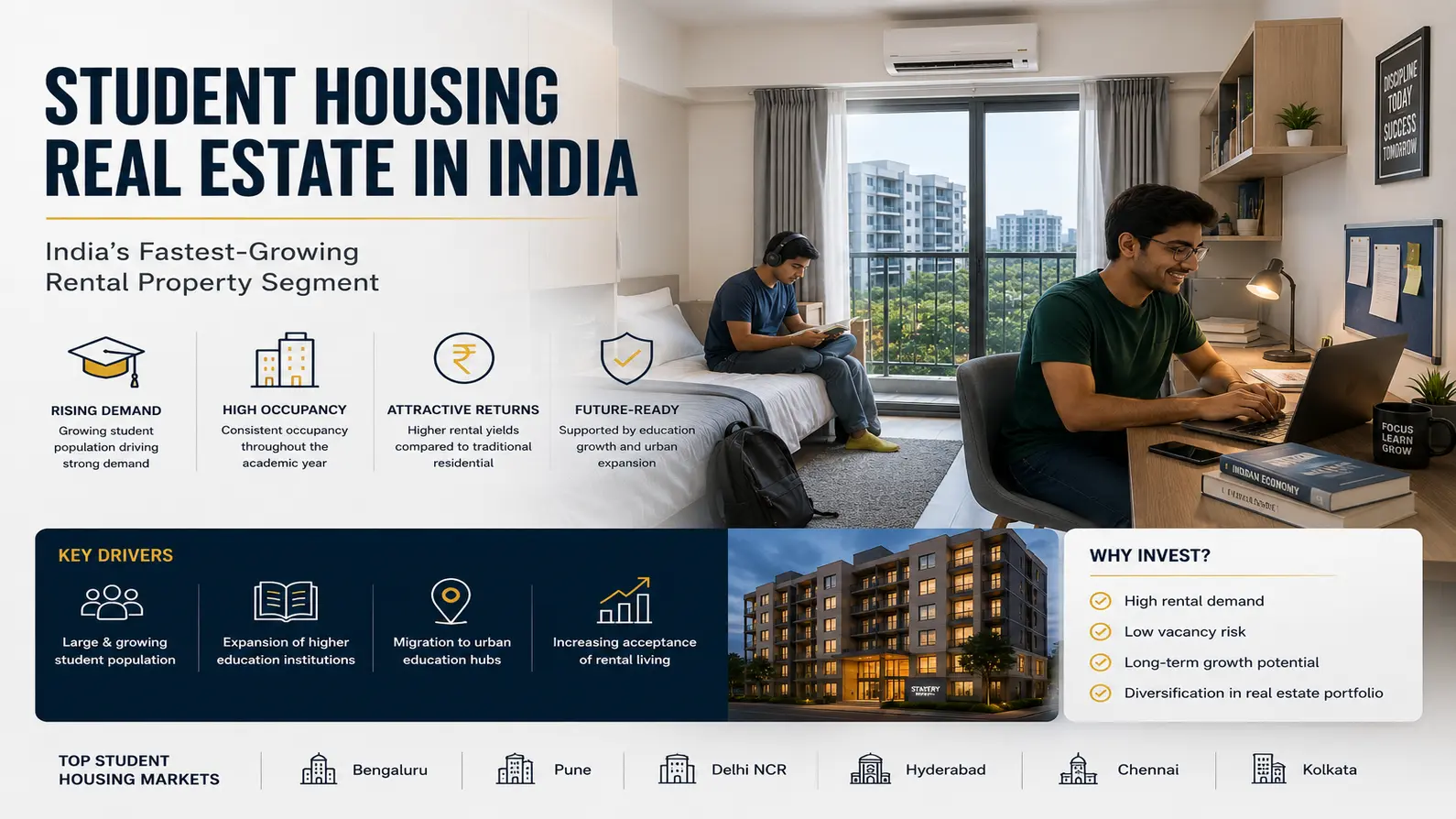
Student housing is emerging as one of India's most exciting and rapidly institutionalising real estate segments in 2026 — driven by an enrolment base of over 43 million students in higher education, the explosive growth of education hubs in cities like Pune, Bengaluru, Hyderabad, Chennai, and Delhi, and a critical shortage of quality purpose-built student accommodation that leaves the vast majority of India's students dependent on unorganised, unsafe, and substandard private hostels and paying guest accommodations. India's organised student housing market penetration stands at just 5% in 2026 — against a global average of 20–25% in developed markets — with organised inventory expected to double in the next 1–2 years, improving penetration to 8–10%. This gap represents one of the most structurally attractive real estate investment opportunities available in India — combining stable, near-100% occupancy, recession-proof demand, premium yields of 8–12%, and the powerful demographic tailwind of India's world's-largest young population entering higher education in record numbers. This complete guide covers everything investors and real estate professionals need to know about India's student housing real estate market in 2026. 43M+ Higher education students India 5% Organised housing penetration 2026 2x Inventory doubling in 1–2 years 8–12% Target rental yield annually Student housing real estate — also called Purpose-Built Student Accommodation (PBSA) — refers to professionally managed residential facilities designed specifically for students enrolled in colleges, universities, and professional education institutes. Unlike conventional rental apartments or unmanaged PG (paying guest) accommodations, PBSA offers standardised quality, professional management, built-in security, high-speed internet, study zones, recreational facilities, and structured community programmes — within walking distance or convenient commuting distance of the anchor education institution. In mature markets like the UK, US, and Australia, student housing is a major institutional real estate asset class — attracting pension funds, sovereign wealth funds, and specialist REITs. India is at the very beginning of this institutionalisation journey — representing exactly the early-stage opportunity that co-living and warehousing offered investors five to ten years ago. India has the world's largest higher education system by enrollment — with over 43 million students enrolled across more than 1,000 universities and 40,000+ colleges. The Gross Enrolment Ratio (GER) in higher education is rising steadily — from 27% in 2022 toward the government's target of 50% by 2035 — meaning the student population will continue growing rapidly for the next decade. Every percentage point increase in GER adds approximately 1–1.5 million new students to India's higher education system — all requiring housing. India's top education cities — Pune, Bengaluru, Hyderabad, Chennai, Delhi, Kota, Manipal, and Pilani — attract students from across the country and increasingly from overseas. Students relocating from other cities or states for quality education represent a captive, long-term rental demand with near-zero vacancy risk during academic years. Unlike office tenants who may relocate or downsize, student housing demand in established education hubs is structurally locked in by the institutions themselves. India's universities and colleges are chronically unable to meet their own hostel demand — most institutions can house fewer than 20–30% of their students on campus. The remaining 70–80% are forced into unorganised private PG accommodations — which are often unsafe, poorly maintained, overcrowded, and without basic amenities. This chronic institutional shortage is what creates the fundamental demand for organised PBSA — and makes student housing one of the most supply-constrained rental real estate markets in India. India's middle and upper-middle class parents are increasingly willing to pay premium rates for safe, well-managed, technology-enabled student accommodation that matches the quality and security standards they expect for their children. The willingness to pay ₹8,000–₹25,000 per month for quality managed student housing — versus ₹4,000–₹8,000 for traditional PG — is creating a premium tier within student housing that is driving the sector's institutionalisation and profitability. India's National Education Policy 2020 ambition to attract 200,000 international students by 2030 — combined with the establishment of international university campuses in India under the UGC's foreign institution framework — is creating a new demand category for premium, internationally-standard student accommodation. International students from South Asia, Southeast Asia, and Africa studying at Indian universities demand quality housing that significantly exceeds current PG standards — creating a premium PBSA opportunity that is still entirely unaddressed in 2026. Pune - India's Education Capital - Largest student housing market. 300+ colleges, 5 universities. Stanza Living, Good Host Spaces, and multiple operators. ₹8,000–₹20,000/month Bengaluru - Tech Education Hub - IIT, IISC, 100+ engineering colleges. Premium PBSA demand near Electronic City and Whitefield corridors. ₹10,000–₹25,000/month Hyderabad - Growing Fast - BITS Pilani Hyderabad, IIT Hyderabad, 200+ colleges. Stanza Living's largest market. Strong demand growth in 2026 Delhi NCR - Largest Student Population - DU, JNU, Amity, 500+ colleges. Huge unorganised PG market transitioning to organised PBSA. Massive opportunity Kota - Coaching Capital - Unique market — 200,000+ students for JEE/NEET coaching. Captive, recurring, year-round demand. Underserved by organised operators Chennai - South India Hub - IIT Madras, Anna University, 300+ colleges. Strong South Indian student migration. Stanza Living and NestAway presence Key investment case: Student housing near anchor education institutions delivers occupancy rates of 95–99% — among the highest of any residential rental asset class in India — with near-zero vacancy risk during academic years and 8–14% annual rental yields that significantly outperform conventional residential rentals. Read also: Senior Living Real Estate India 2026 — student housing and senior living are both emerging alternative residential segments being institutionalised simultaneously in 2026. Stanza Living — India's largest organised student housing operator — 75,000+ beds across 24 cities; tech-enabled management Good Host Spaces — Pune-focused premium student accommodation operator NestAway — Co-living and student housing hybrid — strong in Bengaluru and Chennai Your Space — Premium PBSA operator near premium university campuses Settl. — Co-living and student accommodation in Bengaluru and Hyderabad CoLive — South India co-living and student housing specialist Read also: Rental Property Investment in India 2026 — student housing is India's highest-yielding residential rental investment category. "Student housing in India in 2026 is exactly where co-living was in 2018 and warehousing was in 2015 — a massive, underpenetrated, structurally demand-driven sector on the cusp of institutional adoption. The investors and real estate professionals who recognised warehousing early built exceptional portfolios. Student housing is today's equivalent opportunity." Want to build expertise in India's emerging alternative real estate segments? IREED Academy's comprehensive curriculum covers student housing, co-living, senior living, and every dimension of India's evolving residential property market. Student housing real estate in India in 2026 represents one of the clearest, most structurally supported, and most institutionally validated alternative real estate investment opportunities available. With 43 million students, 5% organised penetration, near-100% occupancy rates, 8–14% annual yields, and organised inventory expected to double in 1–2 years — the demand-supply dynamics are as compelling as any sector in Indian real estate today. The segment is at the same inflection point that co-living occupied in 2018 and warehousing in 2015 — about to experience rapid institutionalisation, significant capital inflows, and the entry of specialist operators that will professionalise and scale organised supply. For investors who recognise this window, and for real estate professionals who develop genuine expertise in this segment, student housing offers exceptional first-mover advantage in India's next major alternative real estate story. Student housing real estate India 2026 — quick reference: Market: 43M+ students, 1,000+ universities, 40,000+ colleges Penetration: Just 5% organised — doubling to 8–10% in 1–2 years Occupancy: 95–99% — highest of any residential rental segment Yields: 8–14% annually — premium to conventional residential Top cities: Pune, Bengaluru, Hyderabad, Delhi NCR, Kota, Chennai Top operators: Stanza Living (75,000+ beds), Good Host, NestAway, CoLive New demand: International students — NEP 2020 target of 200,000 by 2030 Investment signal: Comparable to co-living 2018, warehousing 2015What is student housing real estate?
What is driving student housing demand in India 2026
Driver 01 - World's Largest Higher Education System - 43 Million Students
Driver 02 - Education Hubs Drawing Students from Across India
Driver 03 - Institutional Hostel Shortage - Chronic and Systemic
Driver 04 - Rising Student Expectations and Parental Income
Driver 05 - International Student Growth - India as Education Destination
Top student housing markets and operators in India 2026
Student housing investment — key metrics 2026
Top student housing operators in India 2026
Conclusion


Trending Topics
REAL ESTATETRENDINGPOLITICSTECHNOLOGYBUSINESSHEALTH
IREED Associate Aug 31, 2026
Frequently Asked Questions
📊 Popular Reads
Loading items...